
PART II - WHERE INDIA STANDS TODAY Chapter 8 Olympic Medal Analysis 1952 to 2032 India's Olympic Journey: History, Reality, and the Road to 2036 Olympic medals are not won by chance. Every medal is the outcome of years of planning, world class coaching, scientific training, and a strong high performance system. 8.1 Introduction The Olympic Games represent the highest level of international sport. They serve as the ultimate benchmark for evaluating a nation's sporting ...
PART II - WHERE INDIA STANDS TODAY
Chapter 8
Olympic Medal Analysis 1952 to 2032
India's Olympic Journey: History, Reality, and the Road to 2036
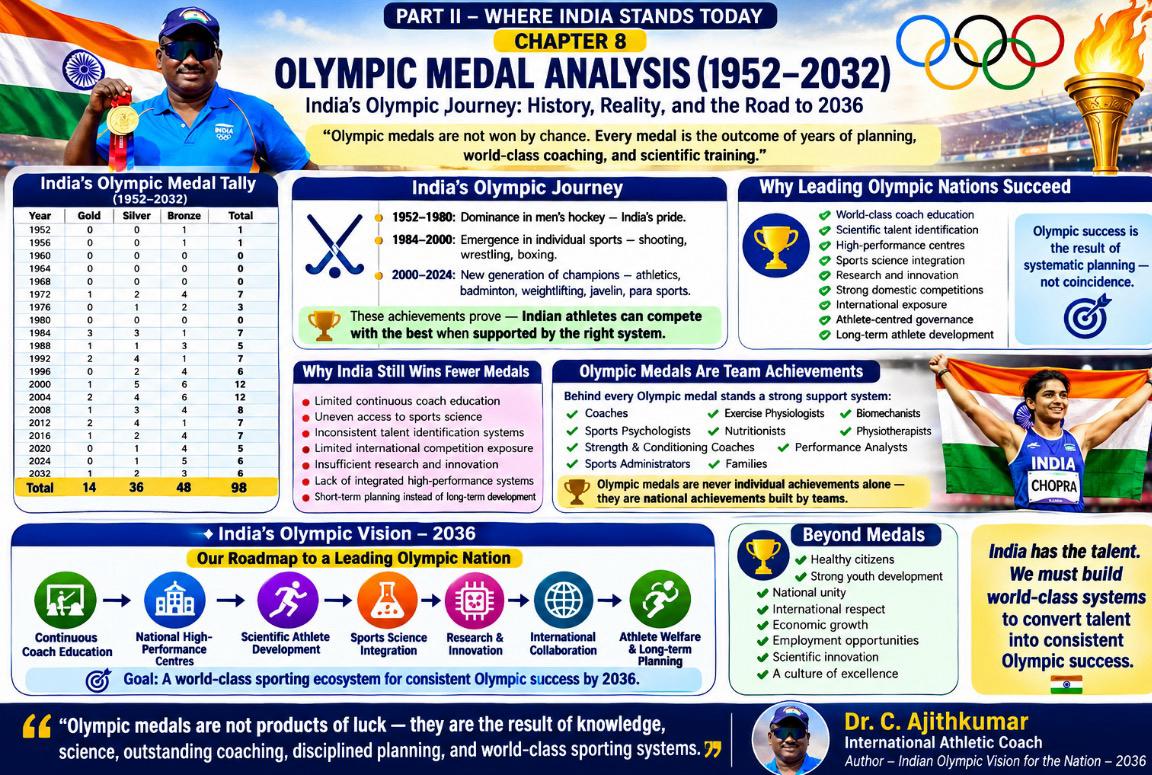
Olympic medals are not won by chance. Every medal is the outcome of years of planning, world class coaching, scientific training, and a strong high performance system.
8.1 Introduction
The Olympic Games represent the highest level of international sport. They serve as the ultimate benchmark for evaluating a nation's sporting excellence, coaching standards, sports science, governance, and athlete development systems.
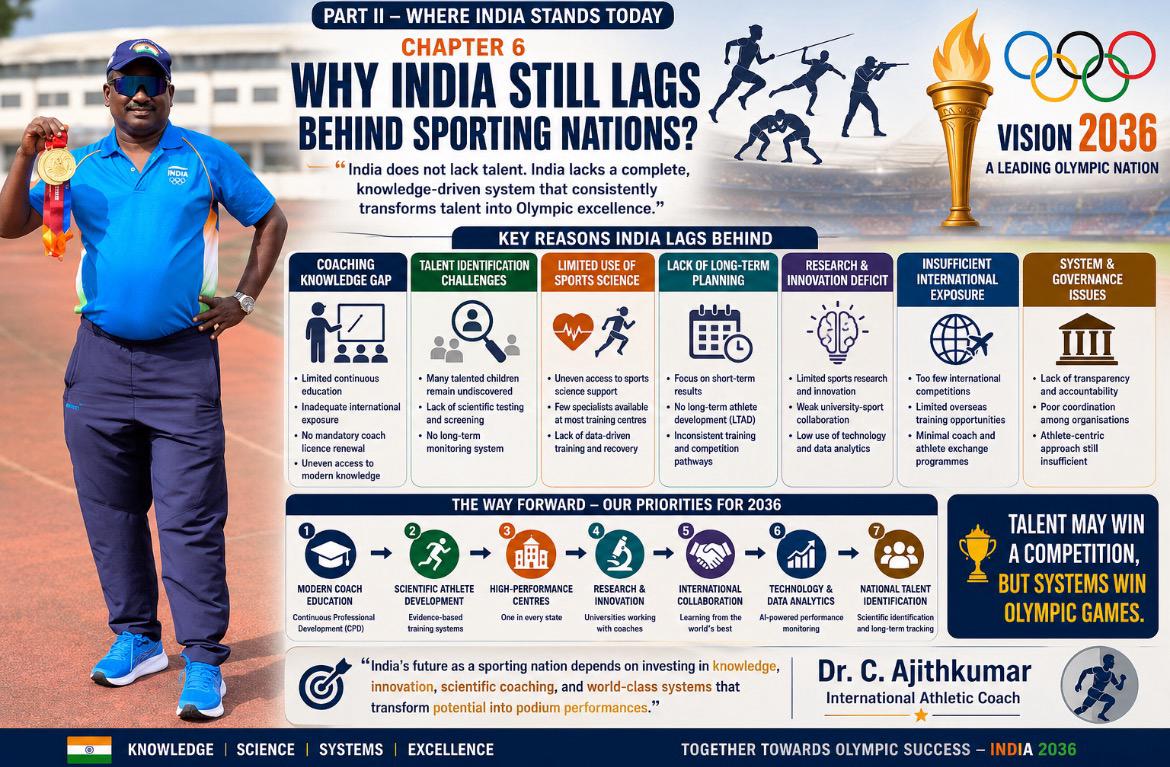
Although India possesses one of the world's largest youth populations and immense sporting potential, its Olympic medal tally has remained modest compared to leading sporting nations.
As India prepares for its vision of becoming a global sporting power by 2036, it is essential to analyse its Olympic journey, identify the existing performance gaps, and develop a roadmap for sustainable success.
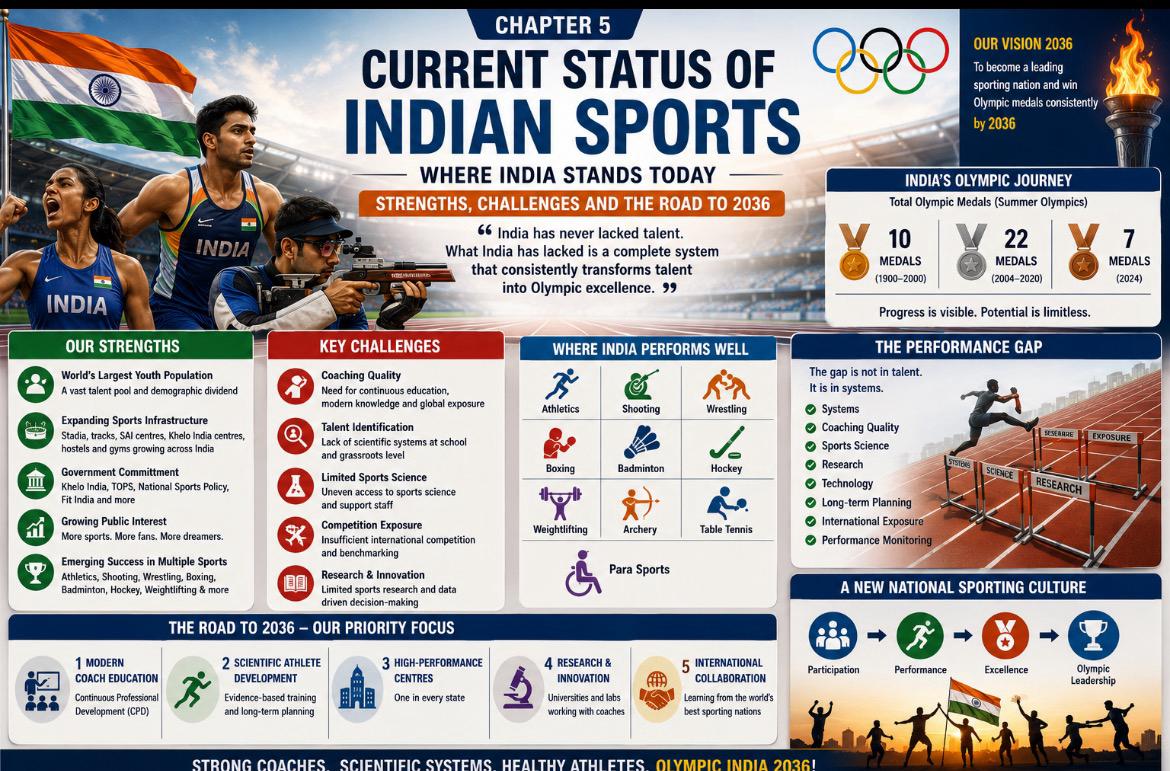
8.2 India's Olympic Journey from 1952 to 2032
India's Olympic history has been marked by moments of brilliance as well as long periods of limited success.
In the early decades, India's international reputation was built largely on men's hockey, which dominated world sport for many years.
In recent decades, India has expanded its success across multiple Olympic disciplines, including:
- Athletics
- Shooting
- Wrestling
- Boxing
- Badminton
- Weightlifting
- Hockey
- Javelin Throw
- Para Sports
These achievements demonstrate that Indian athletes are capable of competing with the world's best when supported by the right system.
8.3 What Makes Leading Olympic Nations Successful?
Countries such as the United States, China, Japan, Australia, Great Britain, and Germany consistently dominate the Olympic medal table because they have invested in long term sporting systems.
Their common strengths include:
- World class coach education.
- Scientific talent identification.
- High Performance Centres.
- Sports science integration.
- Research and innovation.
- Strong domestic competitions.
- International exposure.
- Athlete centred governance.
- Long term athlete development.
Olympic success is the result of systematic planning, not coincidence.
8.4 India's Progress
India has made remarkable progress during the last two decades.
Historic performances by Indian athletes have inspired a new generation and increased public confidence in Olympic sport.
Government initiatives, improved infrastructure, corporate sponsorship, sports science support, and greater media attention have contributed significantly to this transformation.
However, India must now move from sporadic success to consistent excellence.
8.5 Why India Still Wins Fewer Medals
India's challenge is no longer the availability of talent.
The real limitations include:
- Limited continuous coach education.
- Uneven access to sports science.
- Inconsistent talent identification systems.
- Limited international competition exposure.
- Insufficient research and innovation.
- Lack of integrated high performance systems.
- Short term planning instead of long term athlete development.
Closing these gaps is essential for Olympic success.
8.6 Olympic Medals Are Team Achievements
Behind every Olympic medal stands an entire support system.
Success depends on the coordinated efforts of:
- Coaches.
- Exercise Physiologists.
- Biomechanists.
- Sports Psychologists.
- Nutritionists.
- Physiotherapists.
- Strength and Conditioning Coaches.
- Performance Analysts.
- Sports Administrators.
- Families.
Olympic medals are never individual achievements alone. They are national achievements built by teams.
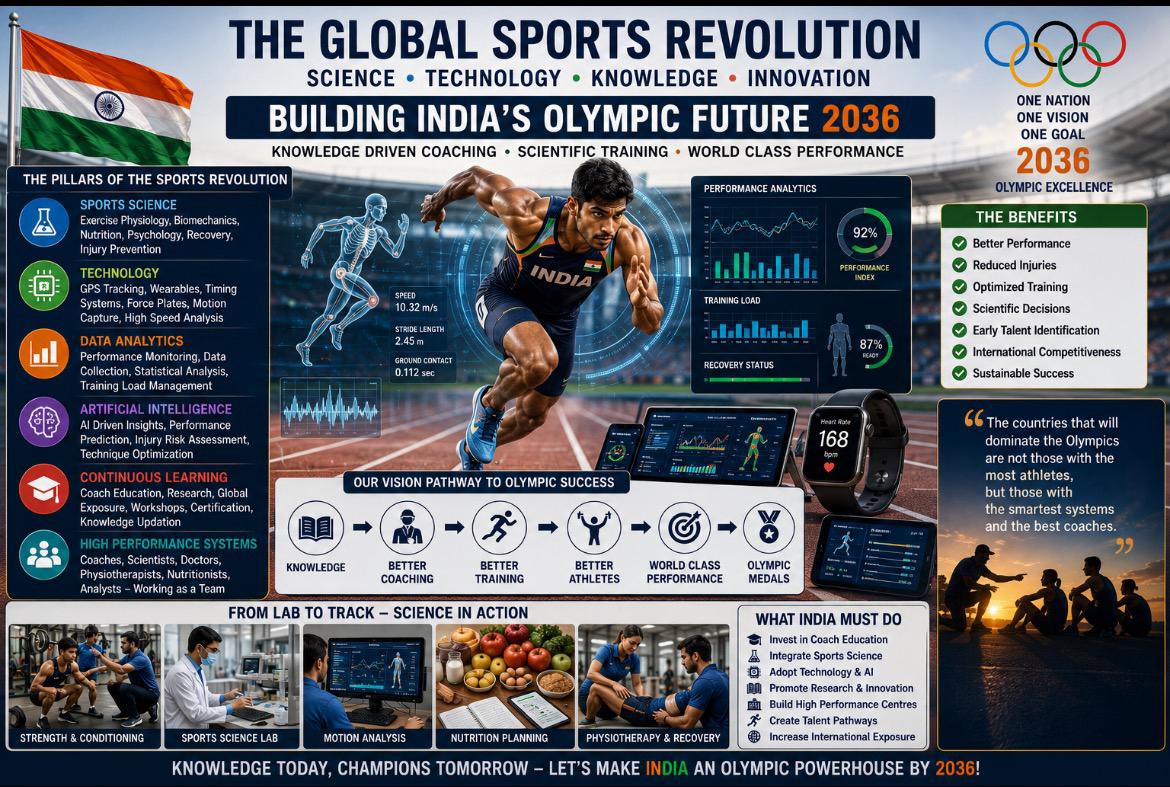
8.7 India's Olympic Vision 2036
India's objective should not simply be to increase its medal tally.
The larger objective should be to establish one of the world's strongest sporting ecosystems.
This requires:
- Continuous Coach Education.
- National High Performance Centres.
- Scientific Athlete Development.
- Sports Science Integration.
- Research and Innovation.
- Artificial Intelligence and Performance Analytics.
- International Collaboration.
- Athlete Welfare Programmes.
- Long Term Planning.
A strong system will consistently produce world class athletes.
8.8 Olympic Success Beyond Medals
Olympic success is measured by more than medals.
A successful sporting nation also creates:
- Healthy citizens.
- Strong youth development.
- National unity.
- International respect.
- Economic opportunities.
- Employment in the sports industry.
- Scientific innovation.
- A culture of excellence.
Sport becomes a powerful instrument for national development.
Conclusion
India's Olympic journey from 1952 to 2032 reflects both remarkable progress and significant untapped potential.
The nation possesses exceptional talent, increasing public support, expanding infrastructure, and strong ambitions.
The next stage of India's sporting development must focus on:
- Coaching excellence.
- Sports science.
- Research.
- Technology.
- Innovation.
- International collaboration.
- Long term athlete development.
If India builds a world class sporting ecosystem, the dream of becoming a leading Olympic nation by 2036 can become a reality.
Olympic medals are not products of luck. They are the result of knowledge, science, outstanding coaching, disciplined planning, and world class sporting systems.
Key Policy Recommendation
India should launch an Olympic Performance Mission 2036, integrating coach education, sports science, research, technology, athlete welfare, performance analytics, and long term athlete development into a unified national high performance framework.
The goal should not only be to win more medals but to establish India as one of the world's leading sporting nations for generations to come.
Dr C Ajithkumar
International Athletic Coach
Author, Indian Olympic Vision for the Nation 2036