
PART II - WHERE INDIA STANDS TODAY Chapter 5 Current Status of Indian Sports India has never lacked talent. What India has lacked is a complete system that consistently transforms talent into Olympic excellence. 5.1 Introduction India is witnessing a remarkable transformation in sports. Over the last two decades, Indian athletes have achieved historic success at the Olympic Games, Paralympic Games, World Championships, Asian Games, and Commonwealth Games. These achieveme...
PART II - WHERE INDIA STANDS TODAY
Chapter 5
Current Status of Indian Sports
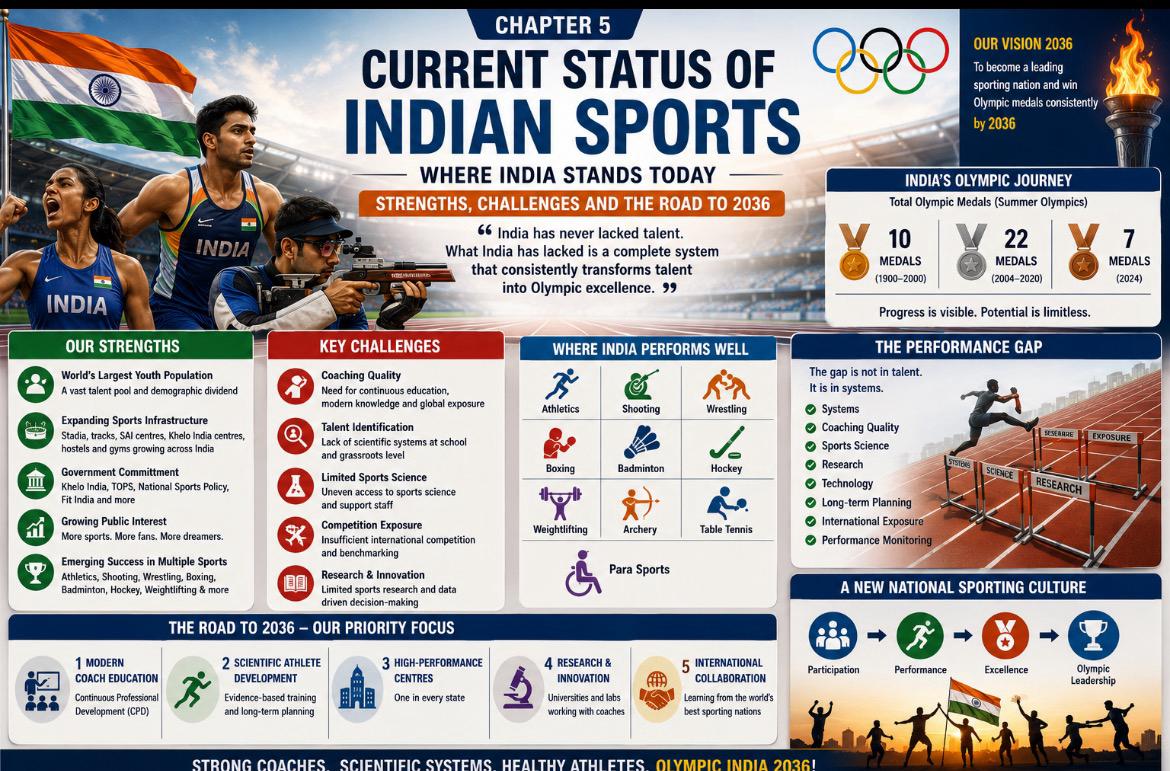
India has never lacked talent. What India has lacked is a complete system that consistently transforms talent into Olympic excellence.
5.1 Introduction
India is witnessing a remarkable transformation in sports. Over the last two decades, Indian athletes have achieved historic success at the Olympic Games, Paralympic Games, World Championships, Asian Games, and Commonwealth Games. These achievements reflect the country's growing sporting ambition and increasing investment in athlete development.
Government initiatives, corporate support, sports science, and public interest have all contributed to this progress. However, despite these positive developments, India's overall Olympic performance remains significantly below that of leading sporting nations.
With the vision of becoming a global sporting power by 2036, India must honestly evaluate its current sporting ecosystem, including its strengths, weaknesses, opportunities, and challenges.
5.2 India's Strengths
India possesses several advantages that can support its Olympic vision.
1. World's Largest Youth Population
More than half of India's population is below the age of 30.
This represents one of the world's largest reservoirs of sporting talent.
2. Expanding Sports Infrastructure
Over the past decade, India has invested in:
- International stadiums
- Synthetic athletics tracks
- Sports hostels
- High Performance Centres
- Sports Authority of India centres
- University sports facilities
- Khelo India Centres
Sports infrastructure continues to improve steadily across the country.
3. Government Commitment
Several important national initiatives have strengthened Indian sport, including:
- Khelo India
- Target Olympic Podium Scheme (TOPS)
- National Sports Policy
- Fit India Movement
- Sports Science Support Programmes
These initiatives demonstrate increasing national commitment toward sporting excellence.
4. Growing Public Interest
Indian sport is no longer limited to cricket.
Athletics, badminton, wrestling, boxing, shooting, hockey, weightlifting, table tennis, and many other sports are receiving greater public attention than ever before.
This growing interest creates new opportunities for talent development.
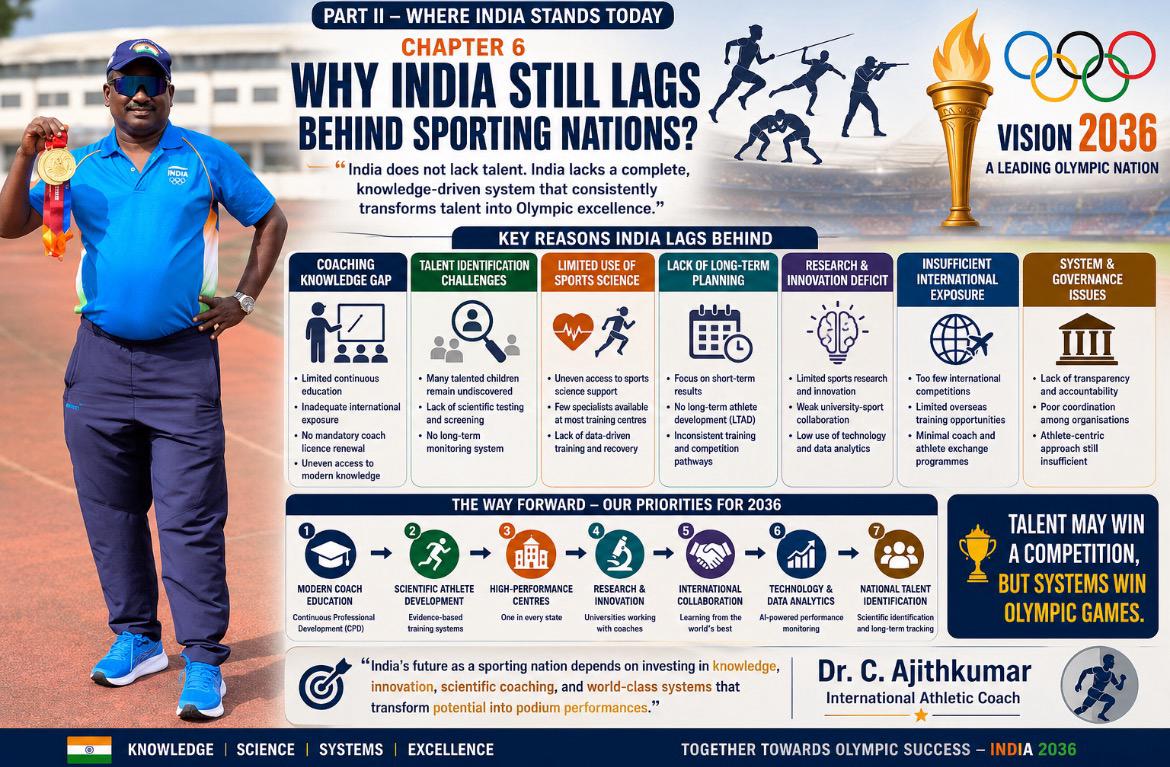
5.3 India's Major Challenges
Coaching Quality
Many Indian coaches work with dedication and experience.
However, several challenges remain:
- Limited opportunities for continuous knowledge updation.
- Inadequate international exposure.
- Uneven access to modern sports science.
- Variations in coach education across different states.
Coach development must become a national priority.
Talent Identification
Many talented children remain undiscovered.
India requires:
- Scientific talent identification.
- Regular athlete testing.
- School based athlete screening.
- Long term performance monitoring.
Sports Science
Sports science support remains concentrated within elite centres.
Every serious athlete should have access to:
- Exercise Physiologists
- Biomechanists
- Nutritionists
- Sports Psychologists
- Physiotherapists
- Strength and Conditioning Coaches
Competition Structure
Many athletes compete too infrequently at the international level.
Regular international exposure is essential for Olympic success.
Research
Sports research in India remains limited.
Universities should become centres of innovation in:
- Performance science
- Coaching science
- Injury prevention
- Biomechanics
- Sports technology
5.4 Where India Performs Well
India has demonstrated growing strength in several Olympic and international sports, including:
- Athletics
- Shooting
- Wrestling
- Boxing
- Badminton
- Hockey
- Weightlifting
- Archery
- Table Tennis
- Para Sports
These sports should continue receiving long term support while India expands excellence into new disciplines.
5.5 The Performance Gap
The difference between India and the world's leading Olympic nations is no longer talent.
The difference lies in:
- Systems
- Coaching quality
- Sports science
- Research
- Technology
- Long term planning
- International competition
- Performance monitoring
Olympic champions are developed through systems, not by chance.
5.6 Why Coach Education Matters
A modern coach must understand:
- Exercise Physiology
- Biomechanics
- Strength and Conditioning
- Sports Nutrition
- Sports Psychology
- Recovery Science
- Performance Analytics
- Artificial Intelligence
- Long Term Athlete Development
Without continuous learning, coaching standards cannot keep pace with international sport.
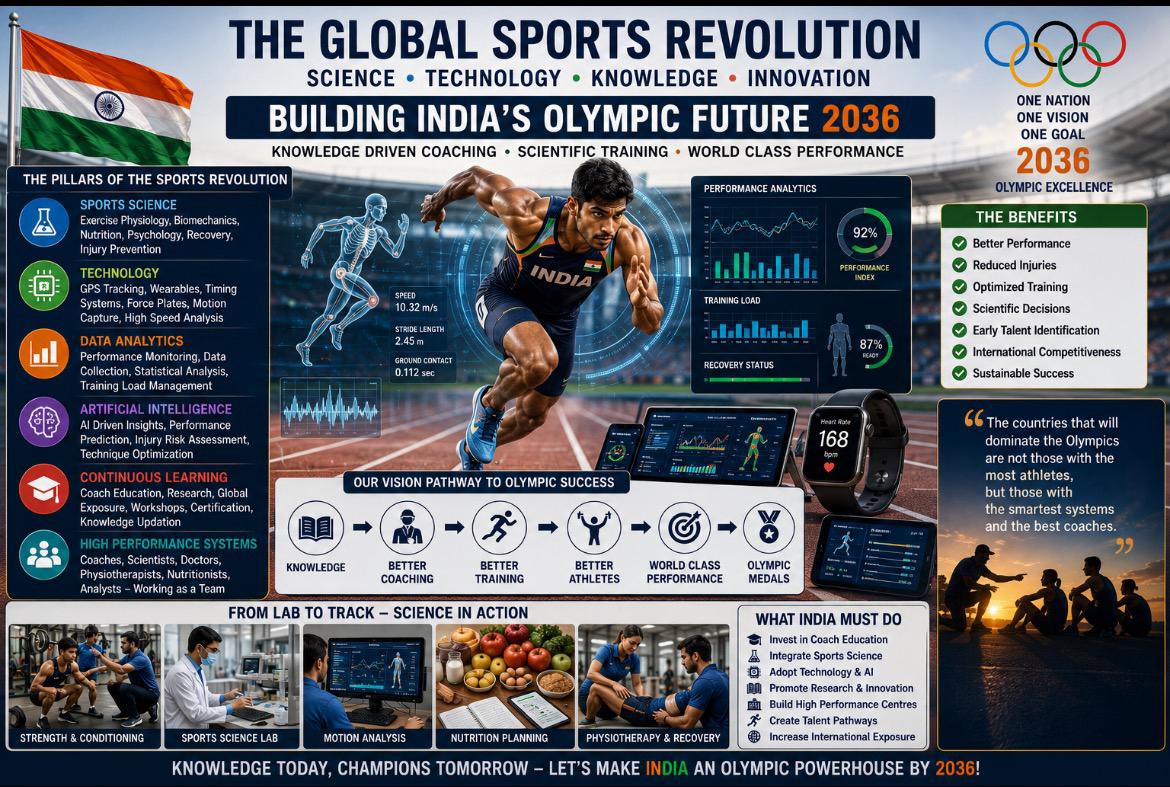
5.7 The Road to 2036
India should focus on five national priorities.
1. Modern Coach Education
Continuous Professional Development for every coach.
2. Scientific Athlete Development
Evidence based training systems across all levels.
3. High Performance Centres
Establish at least one High Performance Centre in every state.
4. Research and Innovation
Universities working closely with coaches and sports organizations.
5. International Collaboration
Learning continuously from the world's leading sporting nations.
5.8 A New National Sporting Culture
India must move from:
Participation
to
Performance
to
Excellence
to
Olympic Leadership
This transformation requires every stakeholder to work together:
- Government
- Coaches
- Universities
- Sports Federations
- Schools
- Parents
- Scientists
- Corporate partners
Olympic success is a national responsibility.
Conclusion
India has entered a promising era in sport.
The nation has talent, ambition, growing infrastructure, and increasing public support.
The next phase of development must focus on knowledge, scientific coaching, research, innovation, and world class athlete development systems.
If India successfully addresses these areas, the dream of becoming a leading Olympic nation by 2036 can become a reality.
India's sporting future will not be determined by the size of its population, but by the quality of its coaches, the strength of its systems, and the courage to embrace continuous learning and innovation.
Key Policy Recommendation
India should establish a National High Performance Sports System that integrates coach education, sports science, research, technology, athlete welfare, and long term athlete development into a single coordinated national framework.
Talent may win a competition, but systems win Olympic Games. The future of Indian sport depends on building world class systems that transform potential into podium performances.
Dr C Ajithkumar
International Athletic Coach