
Sprint Power: Based on Biomechanical Principles
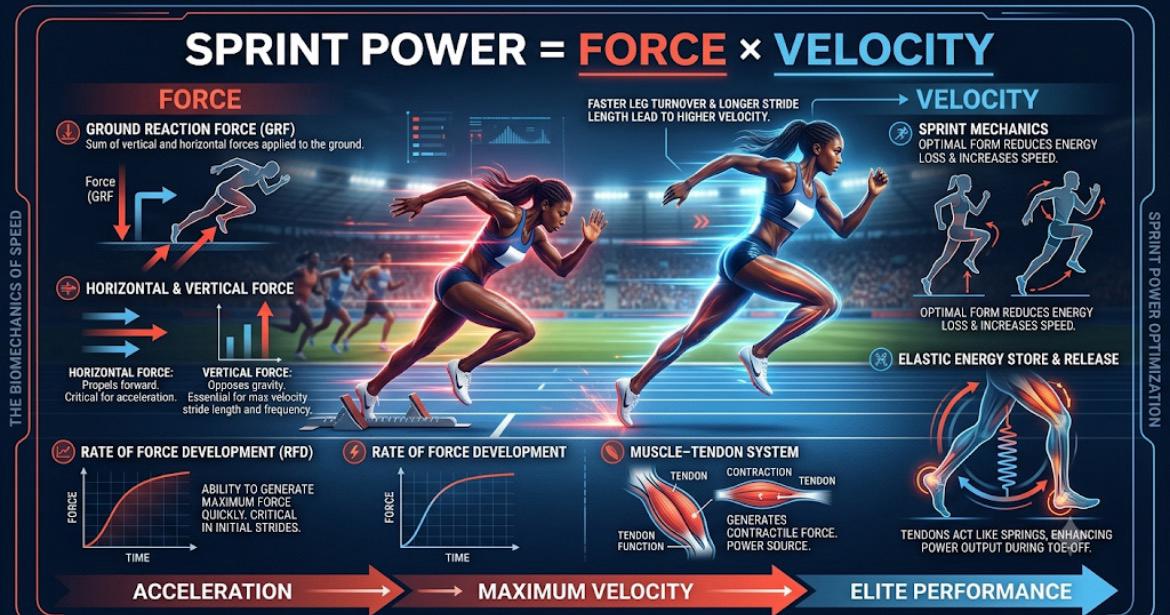
Sprint Power = Force x Velocity
The performance of an elite sprinter does not depend solely on muscle strength or body structure. High level sprint performance is the result of a precise interaction between force, velocity, power, muscle architecture, tendon function, neural coordination, ground reaction force, and sprint mechanics.
A sprinter must be able to apply force to the ground and, within a very short time, direct that force efficiently to produce acceleration and maximum velocity.
1. FORCE - The Foundation
When a sprinter applies force to the ground, the ground produces an equal and opposite Ground Reaction Force (GRF).
Athlete - Ground - Ground Reaction Force - Acceleration
Major muscles involved in sprint force production include:
- Gluteus Maximus - hip extension
- Quadriceps and Vastus Lateralis - knee extension
- Hamstrings - hip extension and knee control
- Gastrocnemius and Soleus - ankle plantarflexion and stiffness
A greater Physiological Cross Sectional Area (PCSA) generally increases the capacity for force production.
However, more muscle size does not necessarily mean better sprint performance.
What matters more is how quickly and efficiently the athlete can use that force, and in which direction the force is applied.
2. VELOCITY - The Speed of Force Application
During sprinting, the time available to produce force is extremely short.
During maximum velocity sprinting, ground contact time may be approximately 0.08 to 0.12 seconds, depending on the athlete and conditions.
Therefore, the important question is not only:
How much force can the athlete produce?
but also:
How quickly can the athlete produce that force?
This is where Rate of Force Development (RFD) becomes critical.
RFD is the ability to rapidly increase force within a short period of time.
An athlete with a high RFD can produce substantial force within a very short ground contact time.
3. MUSCLE ARCHITECTURE
Important structural factors influencing sprint power include:
Muscle Size and PCSA
Muscle size is associated with the athlete's force production capacity.
Fascicle Length
Longer muscle fascicles can support higher muscle shortening velocities and may be advantageous for high speed movements.
Pennation
The arrangement of contractile fibers within a muscle influences its force production characteristics.
Fiber Type
A greater contribution of Type II fast twitch characteristics is generally advantageous for high force, velocity, and power production.
Therefore, an elite sprinter's muscle architecture must allow the athlete to express both high force and high contraction velocity.
4. POWER - The Expression of Strength at Speed
The fundamental equation is:
Power = Force x Velocity
An athlete may be extremely strong. However, if that strength can only be expressed at low movement velocities, its transfer to sprint performance may be limited.
Similarly, an athlete may be very fast but lack sufficient force production, limiting acceleration and ground interaction.
Elite Sprinter: High Force + High Velocity = High Power
Therefore, the goal of sprint training is not simply to increase strength.
A more appropriate progression is:
Strength - Explosive Strength - High Velocity Force - Sprint Power
5. GROUND REACTION FORCE - The Central Element of Sprinting
Ground Reaction Force is fundamental to understanding sprint biomechanics.
The major components include:
Horizontal Force
Particularly important during acceleration.
Vertical Force
Essential for supporting the body and contributing to propulsion during high speed running.
Therefore, how the athlete applies force to the ground directly influences sprint performance.
Force alone is not enough. Force direction matters.
6. ACCELERATION BIOMECHANICS
During acceleration, the athlete generally maintains greater forward body projection.
Key objectives include:
- Increasing horizontal force
- Increasing propulsive impulse
- Using ground contact time efficiently
- Increasing velocity with every stride
Impulse = Force x Time
Therefore, during acceleration, the athlete must generate a large and effective horizontal impulse.
7. MAXIMUM VELOCITY BIOMECHANICS
At maximum velocity, sprint mechanics change.
The athlete:
- Adopts a more upright posture
- Maintains extremely short ground contact times
- Produces high vertical forces
- Must produce force extremely rapidly
- Maintains optimal lower limb stiffness
At this stage, RFD, reactive strength, tendon stiffness, coordination, and limb recovery speed become particularly important.
8. TENDON AND ELASTIC ENERGY
Sprint biomechanics is not driven by muscles alone.
The muscle tendon unit plays a major role.
During ground contact, tendons are loaded and can store elastic energy.
Muscle Force - Tendon Loading - Elastic Energy Storage - Energy Return
This process is an important component of the Stretch Shortening Cycle (SSC).
The Achilles tendon, in particular, plays an important role during high speed running.
Therefore, an elite sprinter requires a combination of:
Strong Muscles + Efficient Tendons + Optimal Stiffness + Rapid Force Production
9. HOW CAN SPRINT POWER BE DEVELOPED?
Maximum Strength
Develop force capacity through exercises such as:
- Squats
- Split squats
- Posterior chain strengthening
Explosive Strength
Teach the athlete to express force rapidly through:
- Jumps
- Olympic lift derivatives
- Ballistic exercises
Reactive Strength
Develop Stretch Shortening Cycle efficiency through:
- Plyometrics
- Bounds
- Hops
- Pogo jumps
High Velocity Sprinting
Develop force velocity qualities through:
- Flying sprints
- Maximum velocity runs
Sprint Mechanics
Improve:
- Posture
- Front side mechanics
- Ground contact
- Limb stiffness
- Force direction
- Coordination
Elite Sprint Performance
10. HOW SHOULD A COACH ASSESS AN ATHLETE?
Assessing an athlete's strength alone is not sufficient.
Force
How much force can the athlete produce?
RFD
How quickly can the athlete produce force?
Velocity
How effectively can the athlete express force at high movement velocities?
Reactive Strength
How efficiently does the athlete use the Stretch Shortening Cycle?
Sprint Mechanics
Can the athlete apply force to the ground in the correct direction and with appropriate timing?
Useful Performance Tests
- 30 m acceleration
- Flying 10 m, 20 m, or 30 m
- Countermovement Jump
- Squat Jump
- Standing Long Jump
- Standing Triple Jump
- Reactive Strength Index (RSI)
- Strength testing
- Sprint video analysis
- Force plate analysis, where available
11. COACHING PERSPECTIVE
A good sprinter is not simply an athlete with large muscle mass.
An elite sprinter combines:
- High Force
- High Velocity
- Rapid Force Development
- Reactive Strength
- Tendon Efficiency
- Optimal Force Direction
- Excellent Sprint Mechanics
THE KEY BIOMECHANICAL PRINCIPLE
Strength is the foundation, but speed determines how effectively that strength becomes sprint performance.
Strength provides the foundation. However, sprint performance depends on how rapidly, efficiently, and in the correct direction that strength can be applied to the ground.
FINAL BIOMECHANICAL MODEL
Muscle Architecture
↓
Force Capacity
↓
Rate of Force Development
↓
Reactive and Elastic Strength
↓
Ground Reaction Force
↓
Force Direction and Sprint Mechanics
↓
Acceleration and Maximum Velocity
↓
Elite Sprint Performance
Sprint power is not simply muscle strength. It is the biomechanical ability to transform force into velocity by applying the right amount of force, in the right direction, at the right time, within an extremely short ground contact period.