
The Biomechanics of Elite Sprinting: Preserving Horizontal Force During Acceleration Prepared by Dr C. Ajithkumar International Athletics Coach Executive Summary Elite sprint performance is governed by biomechanics, neuromuscular efficiency, and an athlete's ability to generate force within increasingly shorter ground contact times. During the acceleration phase, success is determined not by how quickly the legs move, but by how effectively the athlete applies horizontal forc...
The Biomechanics of Elite Sprinting: Preserving Horizontal Force During Acceleration
Prepared by Dr C. Ajithkumar
International Athletics Coach
Executive Summary
Elite sprint performance is governed by biomechanics, neuromuscular efficiency, and an athlete's ability to generate force within increasingly shorter ground contact times. During the acceleration phase, success is determined not by how quickly the legs move, but by how effectively the athlete applies horizontal force into the ground while ground contact time rapidly decreases.
The biomechanical principles discussed in this article explain why world-class sprinters continue accelerating while others plateau. Their advantage lies in preserving forward projection, maintaining horizontal force production, and maximizing impulse transfer despite progressively shorter contact times.
1. The Biomechanics of Ground Contact
Acceleration begins with relatively long ground contact durations that become dramatically shorter with each successive step.
- Step 1: Approximately 0.20 seconds of ground contact provides sufficient time to overcome inertia through powerful horizontal force application.
- Step 2: Contact time decreases to approximately 0.15 seconds.
- Step 3: Ground contact is reduced further to around 0.10 seconds.
- Step 4: During the transition toward maximum velocity, contact time shrinks to only 0.07 seconds.
This rapid reduction creates one of sprinting's greatest mechanical challenges.
Impulse = Force × Time
As contact time decreases, athletes must compensate by dramatically increasing their Rate of Force Development (RFD). Without this ability, acceleration inevitably declines.
2. Horizontal Force: The Defining Difference
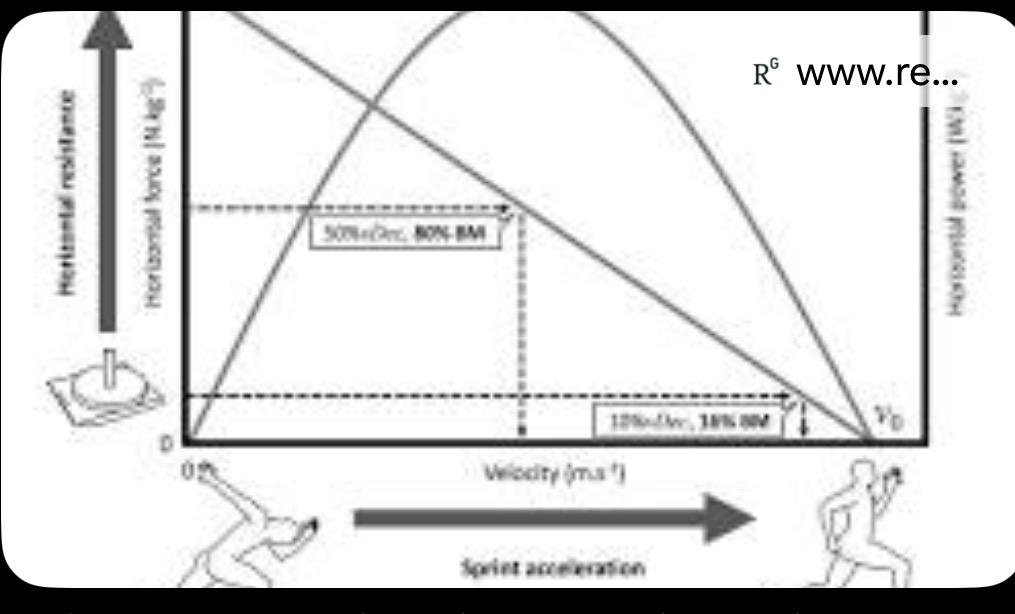
Elite sprinting is fundamentally about preserving horizontal force production.
As running velocity increases, many athletes begin producing less horizontal force. They rise into an upright posture too early, redirect more force vertically, and lose their acceleration advantage.
Elite sprinters demonstrate a different force profile by continuing to generate high levels of horizontal force throughout the acceleration phase.
They achieve this by:
- Maintaining an effective forward lean.
- Directing force backward into the track.
- Resisting premature upright posture.
- Sustaining efficient force orientation as speed increases.
This allows elite athletes to continue accelerating long after average sprinters have reached their peak acceleration.
3. Three Biomechanical Pillars of Elite Acceleration
I. Reactive Ankle Stiffness
The ankle functions as a high-performance spring.
During extremely short ground contact times, it must remain sufficiently stiff to absorb and immediately return elastic energy.
When ankle stiffness is lost:
- Excessive dorsiflexion occurs.
- Energy dissipates.
- Ground contact time increases.
- Horizontal force decreases.
- Acceleration suffers.
Elite sprinters possess exceptional reactive ankle stiffness, allowing efficient force transmission within milliseconds.
II. Directional Body Projection
Acceleration depends on maintaining the body's center of mass ahead of the point of ground contact.
Proper forward projection ensures that ground reaction forces are directed backward into the track, producing maximum forward propulsion.
Standing upright too early changes the direction of force application, reducing horizontal propulsion and limiting further acceleration.
Maintaining projection is therefore a technical necessity rather than simply a postural preference.
III. Rapid Impulse Transfer
As contact time approaches one tenth of a second or less, there is no opportunity to push longer.
Instead, athletes must transfer maximum force almost instantaneously.
Elite sprinters excel because they generate extremely high force in remarkably short time intervals while maintaining precise force direction.
This exceptional neuromuscular efficiency separates world-class performers from average athletes.
Practical Coaching Applications
High-performance sprint training should prioritize:
- Improving Rate of Force Development (RFD).
- Developing horizontal force production.
- Enhancing reactive ankle stiffness.
- Maintaining forward body projection during acceleration.
- Reducing braking forces through optimal foot placement.
- Preserving horizontal impulse as contact time decreases.
Training that focuses only on stride frequency or leg speed without addressing these biomechanical qualities will have limited impact on elite sprint performance.
Conclusion
Elite acceleration is not achieved by moving the legs faster. It is achieved by preserving horizontal force while the available time to produce that force rapidly disappears.
The world's fastest sprinters demonstrate the ability to maintain forward projection, generate exceptional horizontal impulse, and transfer force through a rigid, reactive lower limb within ground contact times of less than 0.10 seconds.
This unique combination of biomechanics, neuromuscular power, and technical precision is what separates international-level sprinters from the rest.
"Acceleration is the art of preserving horizontal force while time disappears. The athlete who maintains projection, ankle stiffness, and impulse transfer the longest will continue accelerating when others begin to slow."
Dr C. Ajithkumar
International Athletics Coach