Asian Athletics: Continental Highlights Report 2026 Outlook
By Dr C Ajithkumar
International Athletics Coach
Asian athletics is entering a decisive competitive phase as nations recalibrate strategies ahead of the 2026 Asian Games. Rising performance standards, stricter qualification systems, and scientific preparation models indicate a structural transition from participation-driven representation to podium-oriented performance architecture.
Asian Games 2026: India's Revised Selection Policy
In a significant policy shift, the Government of India has introduced stricter qualification standards for the 2026 Asian Games cycle.
The New Framework Prioritizes
- Athletes with realistic medal probability
- Benchmarks aligned with projected Asian Top-3 standards
- Data-backed evaluation using recent international results
- Scientific fitness screening and injury monitoring reports
This reflects a clear move toward a performance-first delegation model.
Strategic Implications
- Raised domestic qualifying benchmarks
- Alignment of federations with continental medal metrics
- Early-season peak performance planning
- Increased accountability in coaching and Strength and Conditioning structures
From a high-performance systems perspective, this model mirrors medal-optimized approaches adopted by China, Japan, and Bahrain.
Asian and Southeast Asian Records Under Pressure
Across East and Southeast Asia, sprinting and middle-distance disciplines are experiencing measurable acceleration.
Recent continental patterns indicate:
- Emerging sub-10.00 depth in elite Asian men's 100 metres
- Women's sprint marks approaching long-standing continental records
- Strong progression in 5,000 metres and 10,000 metres standards
- Increasing relay competitiveness across ASEAN nations
The Southeast Asian Games has evolved into a significant development pipeline, producing athletes capable of transitioning into Asian-level finals.
Performance Implications
- Narrowing competitive gap between East, South, and West Asia
- Higher frequency of national record breakthroughs
- Expanded biomechanical and physiological investments
- Continental finals demanding near world-class qualification marks
Sprint depth expansion is especially notable, with federations investing in block-start force analysis, velocity-based strength training, altitude exposure strategies, and lactate-threshold modelling.
Preparation for Competition in Japan: Beyond Physical Training
With the Games scheduled in Japan, preparation strategies now extend beyond physical conditioning.
Environmental and Cultural Adaptation Strategy
Indian and other Asian teams are incorporating:
- Logistical and punctuality familiarization
- Nutritional adaptation planning
- Circadian rhythm alignment protocols
- Cultural orientation modules
Projected climate variables during the September to October window include moderate humidity and transitional temperature patterns. Teams are planning early exposure training blocks in similar environments, heat-acclimatization cycles, and tactical simulation competitions.
Marginal gains are expected to determine medal outcomes.
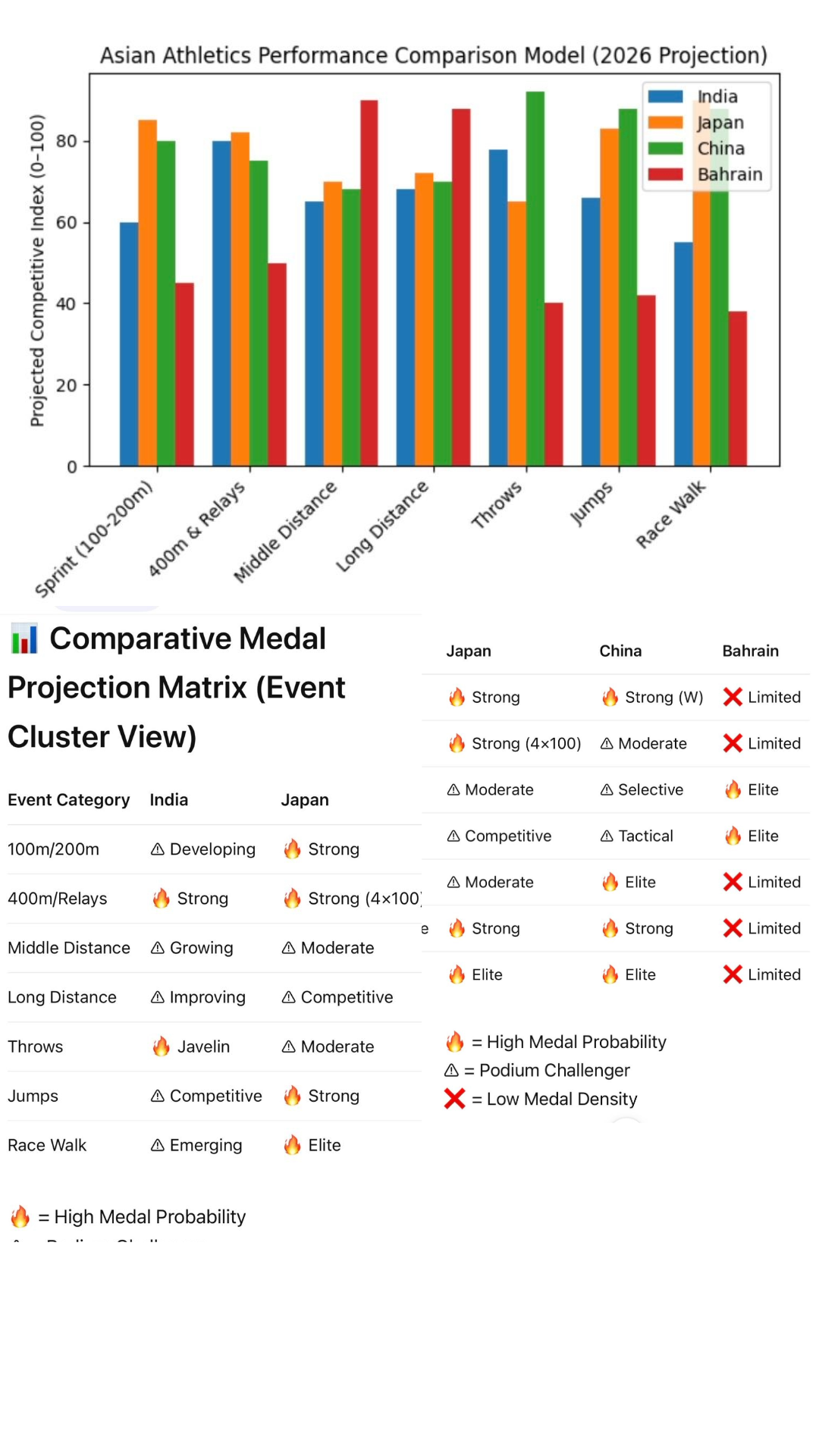
Event-Wise Asian Ranking Comparison: Performance Trend Outlook 2025-2026
India
Strong Events
- Men's Javelin
- 3000 metres Steeplechase
- Women's 100 metres Hurdles
- 4 by 400 metres Relays
- Emerging long-distance cluster
Competitive Tier
Finalist-to-medal transition phase.
Medal Density Projection
- Field Events and Relays: High
- Pure Sprint 100m and 200m: Moderate
- Middle Distance: Developing
India's challenge lies in building sprint depth below 200 metres and enhancing championship conversion rates.
Japan
Strong Events
- Men's 100 metres and 200 metres
- 4 by 100 metres Relay
- Race Walk
- Technical Field Events
Competitive Tier
High-efficiency championship system.
Medal Density Projection
- Sprint: High
- Race Walk: Very High
- Throws: Moderate
Japan's university athletics ecosystem sustains long-term sprint depth and relay precision.
China
Strong Events
- Shot Put, Discus, Hammer
- Women's Sprint and Hurdles
- Jumps
- Race Walk
Competitive Tier
Continental powerhouse.
Medal Density Projection
- Throws: Very High
- Women's Sprint and Hurdles: High
- Endurance: Selective Strength
China maintains the highest medal conversion ratio in Asian field events.
Bahrain
Strong Events
- 800 metres and 1500 metres
- 5000 metres and 10,000 metres
- Women's Middle Distance
Competitive Tier
Endurance-focused medal specialist.
Medal Density Projection
- Middle Distance: Very High
- Sprint and Field: Limited Depth
Bahrain's targeted investment model concentrates on middle-distance dominance.
Strategic Insight Toward 2026
India's Best Medal Return Strategy
- Protect and optimize 4 by 400 metres relay systems
- Expand throws beyond javelin specialization
- Increase sprint depth through biomechanical integration
- Enhance 800 to 1500 metres tactical championship maturity
Key Continental Rivalries
- India versus Japan in sprint and relay supremacy
- India versus China in field-event medal clusters
- India versus Bahrain in middle-distance contests
Conclusion
As the road to the 2026 Asian Games progresses, Asian athletics stands at a strategic inflection point. Selection policies are tightening, sprint and endurance records are under pressure, and preparation models are integrating cultural, environmental, and scientific variables.
The next twelve to eighteen months will determine whether Asian athletics transitions from episodic excellence to structured continental supremacy.
Author
Dr C Ajithkumar
International Athletics Coach
Related Articles